Showing posts with label oolong. Show all posts
Showing posts with label oolong. Show all posts
Wednesday, July 7, 2010
Joshua tastes new Taiwanese Oolongs with Walker Tea Review
Joshua sits down with tea enthusiast and reviewer Jason Walker of Walker Tea Review to taste a few of our newest Taiwanese Oolongs. See the video here: Guest Tasting: Joshua Kaiser of Rishi Tea

Wednesday, June 30, 2010
2010 Taiwanese Oolong
High mountain tea is often called by its Chinese name, Gao Shan Cha, and is a category of special oolong teas, the best of which are from Taiwan.
 |
The high mountain tea garden a few hundred meters above the famous "horse saddle" garden in Shan Lin Xi is one of our favorite origins of Taiwan Oolong. |
People like the complex flowery aromas and fresh character of high mountain tea. High mountain oolongs contain less catechin and more amino acids than other oolongs so they are smoother and less astringent than other types of oolong. High mountain teas are in short supply every year. The oolong market demand for the best grades of high mountain tea is greater than the supply, always.
High mountain teas are classified as teas grown higher than 1000 meters above sea level. Many of our Taiwan teas come from middle and lower elevations, as well. Many oolongs are not high-mountain grown and their characters are very sought after and yield distinctive characters that oolong tea consumers look for. For example, many of our teas are from 500-800 meters above sea level, like Jade Oolong and Tae Guan Yin. One of our best quality oolongs, Eastern Beauty, or Hsinchu Bai Hao, is grown at 300-500 meters and this tea can only be made at lower elevations, once per year.
This year we have three high mountain spring teas: one from Shan Lin Xi, one from Li Shan, and High Mountain Dong Ding made in A-Li Shan. We also have two other teas listed below from lower elevations, including our two new Qingxin oolongs: original spring orchid and light baking type.
 |
| The qingxin organic tea farm is bordered by nets and large, unpruned Hong Yue tea trees that create buffer zones to surround the tea garden and minimize windshift from non-organic agriculture. |
High mountain tealeaves grow at a slower rate than the tea cultivated in the medium- and low-growing elevations, due to the cool, humid and misty conditions that shroud the tea fields and filter direct sunlight. Leaves stay tender and immature during the harvest so the leaves are rich in amino acids and theanine and have a lower content of sharp catechin. High mountain teas, or Gao Shan Cha, are priced for their strength and richness without any bitterness or astringency.
 | ||||
| Pheremone light traps, an organic method of pest management are used to minimize bug attacks on the tea bushes in our qingxin tea farm. |
The highest mountain regions in Taiwan for Gao Shan Cha are Da Yu Lin, Li Shan, Shan Lin Xi and A-Li Shan. There are many others. Each season, we taste Gao Shan Cha from all the best farms and select a chosen few, twice a year, when the high mountain teas are harvested. Most high mountain teas are harvested during the spring and winter, although sometimes the conditions are poor and we can only get one harvest a year. Spring tea is noted for its youthful freshness and bright, rich character, and is very balanced among body, flavor, amino acid taste and feeling and aroma. Winter teas accumulate and expend energy through the year and are noted more for their distinctive and complex aromas and strong qi that experts claim the tea bush builds up all year and releases in winter before dormancy.
The weather conditions in high elevations provide low temperatures and ample humidity during harvesting and processing, so many fresh attributes are preserved in the tealeaves, such as aromatic oils, active water and amino acids. The tea bush varietals that grow in the high mountain gardens are mainly Qingxin oolong, which is the type of tea bush that is best suited to high mountain conditions. Qingxin is noted for its high amino acid content, rich taste, patience in brewing and low astringency and bitterness. The high mountain oolongs made with the Qingxin oolong varietal command the highest price in the Taiwan market.
 |
| Electric powered, bamboo roasting baskets are used to create the distinctive nutty aroma and smooth flavor of our 4 x baking, high mountain Dong Ding. |
High mountain oolong tea is best prepared with a guywan or gong fu teapot to enjoy multiple infusions. High mountain teas are also one of the best teas for Hario cold brew pots, using 4-5 tablespoons of tea per liter of cold water. Put in your fridge for 13-16 hours and drink the next day. All of our Taiwan oolong teas can be cold brewed according to this method.
Monday, June 14, 2010
Qingxin Oolong Old Style Baking, Oolong Tea
Qingxin was one of the first two varietals of oolong introduced to Taiwan. Qingxin is the varietal most cultivated for "Gao Shan Cha" in the majority of the high mountain tea farms in Taiwan. When cultivated under the proper conditions, Qingxin has a very smooth yet strong character with evident amino acid flavor and a rich mouthfeel, complimented by fresh evergreen, orchid and rare floral aromas, sometimes with bright fruity accents. We chose to try organic cultivation methods with this "new" Qingshin because it’s a breed that performs well at mid-elevation and is strong against pests, and was highly recommended by a local tea-breeding expert.

To learn more, visit Qingxin Oolong Old Style Baking, Oolong Tea

To learn more, visit Qingxin Oolong Old Style Baking, Oolong Tea
Friday, March 5, 2010
The Enduring Oolong of Compassion: Iron Goddess of Mercy
Originally posted on FoodThinkers.com
Iron Goddess of Mercy
I’ve been buying Tae Guan Yin, or what is known as Iron Goddess of Mercy, from an old friend in Mingjian Village in Nantou, Taiwan, for twelve years. Last November, I was tasting and selecting micro-lots of winter Tae Guan Yin for roasting when there was an earthquake. It was a magnitude 7.0. I had never felt anything like it.
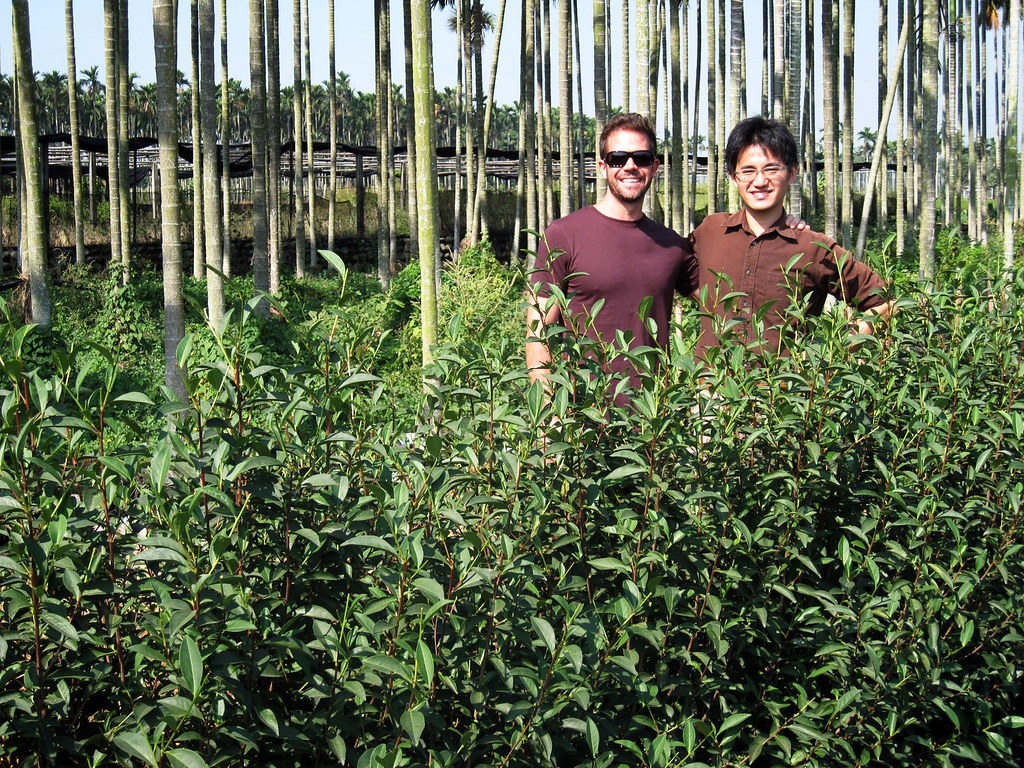
Joshua and his friend of 15 years hanging out in a 4-year-old tea garden planted with Hongxin Waiwei, Wu-Yi, and Qin Xin, all suitable varietals for great Tae Guan Yin.
The Power of Nature
As luck would have it, not one person died. Although magnificent and earth-shaking, it did not devastate, as so many earthquakes of lesser magnitudes have in Taiwan’s recent history. After running from the cupping room, my friend looked at me as we took refuge in the street. He mused, “Guan Yin is with us …” I felt so scared, vulnerable, and lucky to be alive. There was a very real sense that nature was in control of my destiny and it was not for me to decide. I feel even luckier now after seeing the terrible newscasts from Haiti.
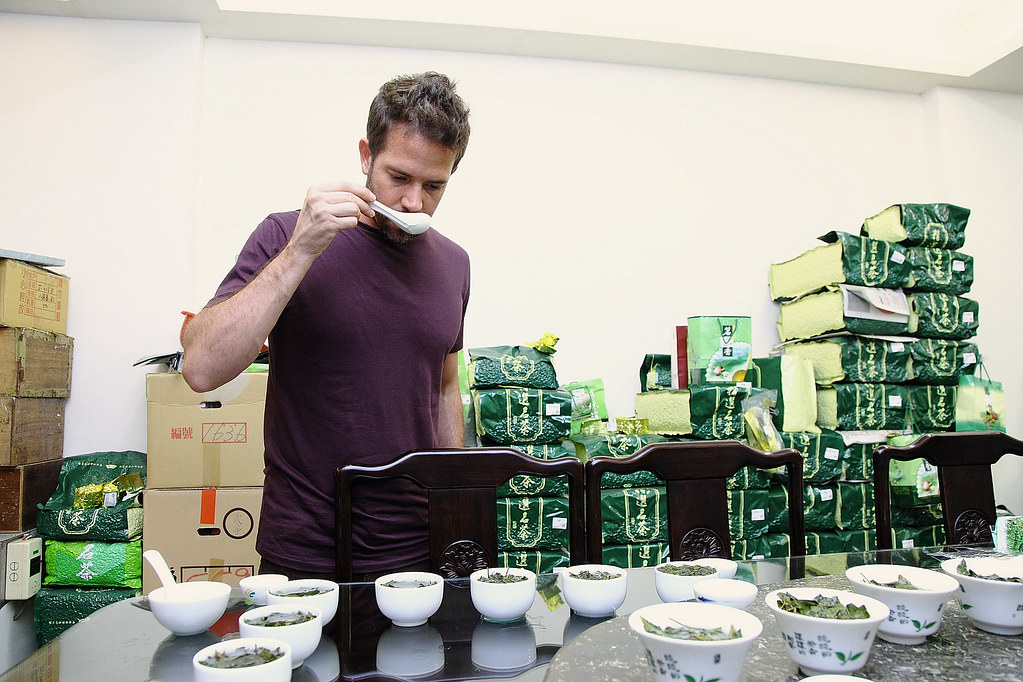
Tasting micro-lots of tea destined to be roasted for Tae Guan Yin just minutes before the earthquake.
Healing Powers of Tea
“Cha Yun” is the rhythm and charm of tea. When can the rhythm of tea rise above the clashes of power, competition, profit, and corporate needs? When can it heal? The commodity of tea has been at the heart of war. But the essence of tea bestows peace and implores us to have mercy.
Tea helps people by providing health benefits and preventing disease. Its cultivation and trade can improve the lives of poor farmers and spread cultural understanding. Tea welcomes friends and unites people. Tea transcends its commercial values and supports the needs of the stricken, as it has done throughout its long history.
I am always reminded that tea is an instrument of peace and human salvation. An enduring symbol of tea’s peaceful essence is the cherished oolong tea, Tae Guan Yin.
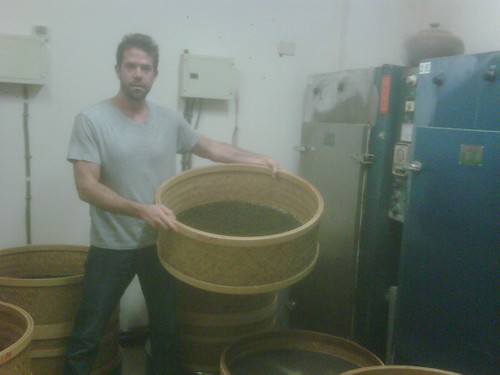
The dark clouds in the room that can be seen, almost like dust, are the crystallized caffeine coming off the tea and clouding the air. The feeling you get after sitting in that room, rotating the braziers is quite powerful, like being drunk with caffeine.
Qi and history
Tae Guan Yin is one of my favorite teas because of its flavor and qi (energy), but also its history, process, and teachings.
Tae Guan Yin is one of the oldest oolong tea bush varietals. It’s also an heirloom of the tea generations and is highly regarded as a profound oolong. For many centuries it was cultivated in Southern Fujian in China. Then it was introduced to Taiwan, where it remains a very important varietal at the center of a long-standing artisan oolong tea tradition.
Tae Guan Yin is a very special group of tea tree varietals that were selected and kept pure by Fujian farmers. It is well suited for making traditional, half-oxidized, ripe, fermented oolong tea with slow and moderate roasting. The traditional fermentation and roasting of Tae Guan Yin aims to provide a slightly acidic and fruity sourness with a smooth mouthfeel and pleasant toasted nut aroma that endures and develops over many infusions.
Slow, moderate roasting is key for Tae Guan Yin. A single batch is roasted in small-batch bamboo braziers multiple times until the right flavor and aroma is attained. The room must be kept at a certain temperature and humidity during the roasting process to ensure even and thorough baking.
Origins of Guan Yin
Tae Guan Yin is more than a splendid tea — it is inspirational. Its origin and legend are at the essential core of what I believe the tea trade can be.
“Guan Yin,” the “Buddhist Goddess of Mercy,” teaches us compassion and encourages us to assist the impoverished and heartbroken. As legend has it, a debt-ridden, poor farmer named Wei Yin from Xiping Village in Anxi, Fujian, was visited by Guan Yin in a dream more than 200 years ago.
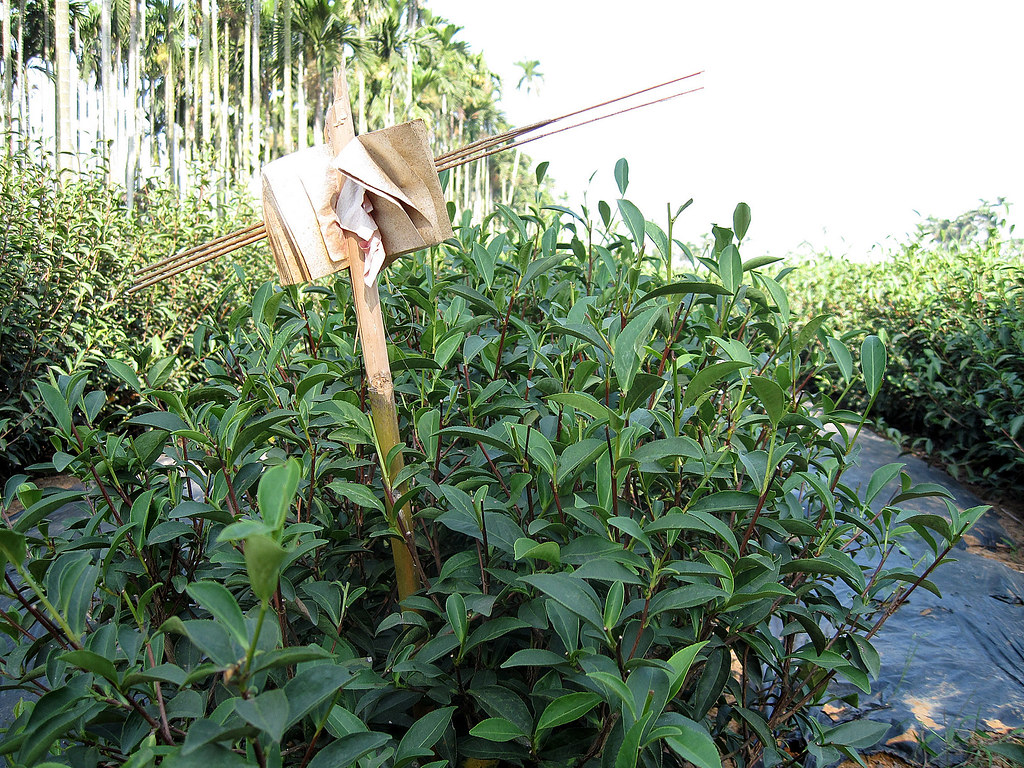
Traditional spirit offering (not a scarecrow) at the head of our newest planted Tae Guan Yin tea garden in Mingjian Village.
Sharing the wealth
Guan Yin told this farmer that she had given him a special tea bush and that by cultivating this tea bush on a certain area of his land, he could make great tea and save his family. He did and soon shared the tea bush with other farmers.
Tae Guan Yin was spread across Anxi, bringing economic prosperity to those that cultivated it. The locals named this tea “Guan Yin” after the Goddess of Mercy. And later, the Emperor Qianlong dubbed the tea “Iron Goddess of Mercy.”
Tea and understanding
My affection for this treasure of a tea and the experience of my last trip to Taiwan to make Tae Guan Yin for Rishi Tea have inspired me to help those in Haiti. The vulnerability, pain, loss, and confusion of the people in Haiti cannot be comprehended by us. We can empathize but never completely understand their despair and helplessness.
Tae Guan Yin is always close to my tea-heart and my teapot for that matter. She is an ever-enduring focus and trusted guide through my life with tea and gong fu cha (the art of brewing tea with great skill). More than ever, Tae Guan Yin is an inspirational symbol of tea’s peaceful essence.
Help for Haiti
The Iron Goddess of Mercy Oolong tea from the winter crop of 2009, which I was tasting and roasting for Rishi Tea during the earthquake, will contribute to peace and well-being in Haiti.Rishi Tea will donate 20% of each purchase to CARE, an international humanitarian organization that is working to help the victims of the recent earthquake in Haiti. Iron Goddess of Mercy reminds us that tea can transcend its commercial values and promote compassion.
Truly in the tea,
Joshua
Joshua
Tuesday, July 21, 2009
Strong & Sturdy like an Old Redwood Tree

Favorite teas come and go like the sun and moon rise and fall, but Feng Huang Dancong Ba Xian is my one tea that I can always come back to, strong and sturdy like an old redwood tree.
I still have a vivid memory of trying this tea for the first time. Sean and I had the privilege of cupping it as soon as it came in. I still remember that small little guywan so packed full of leaves. The small and dainty little lid trying so hard to contain the wonder of this tea, its unique strength and patience lasting through many complex and highly aromatic infusions. I felt like I was floating and glowing fire from the unbelievable chi this tea so willingly gives to all. I have gotten to know this tea over the past few months. Getting to know so many of its facets through my own personal manipulation. You and I can both love this tea and love something completely different about it. Recently, Sean and I revisited this tea again.
GLASS: half full of tealeaves, 180 degree water, rinse, 1st infusion 2 minutes, 2nd infusion 1 minute with the rest going up by 15 seconds.
The first infusion had the fruity and delicate floral aromas I remembered but I craved the bold astringency that I feel gives such great chi.
The second infusion started bringing out that astringency that balances out the delicate notes.
The second infusion started bringing out that astringency that balances out the delicate notes.
Then it happened, the third infusion gave me a combination of the first two with one of the nicest lingering aromas I have tasted in a while. It was as if fragrant blossoms danced on my tongue and filled my senses as I exhaled.
Mondays at work can be pretty stressful with the work of the weekend weighing down on you and the tasks of the week slowly piling up, but we do work at a tea company. My biggest perk is being able to stop and enjoy my water and leaves; taking the time to slow down and forget about the paperwork and voicemails and remember why we are here. My passion is tea and tea is good to me.
Susana Mojica
Student of the leaf and passionate aficionado.
FUN FACT:
The story of these oolongs begin with Zhao Bing, the last emperor of Southern Song Dynasties who fled to Chaozhou , Guangdong Feng Huang Mountains
Subscribe to:
Posts (Atom)